
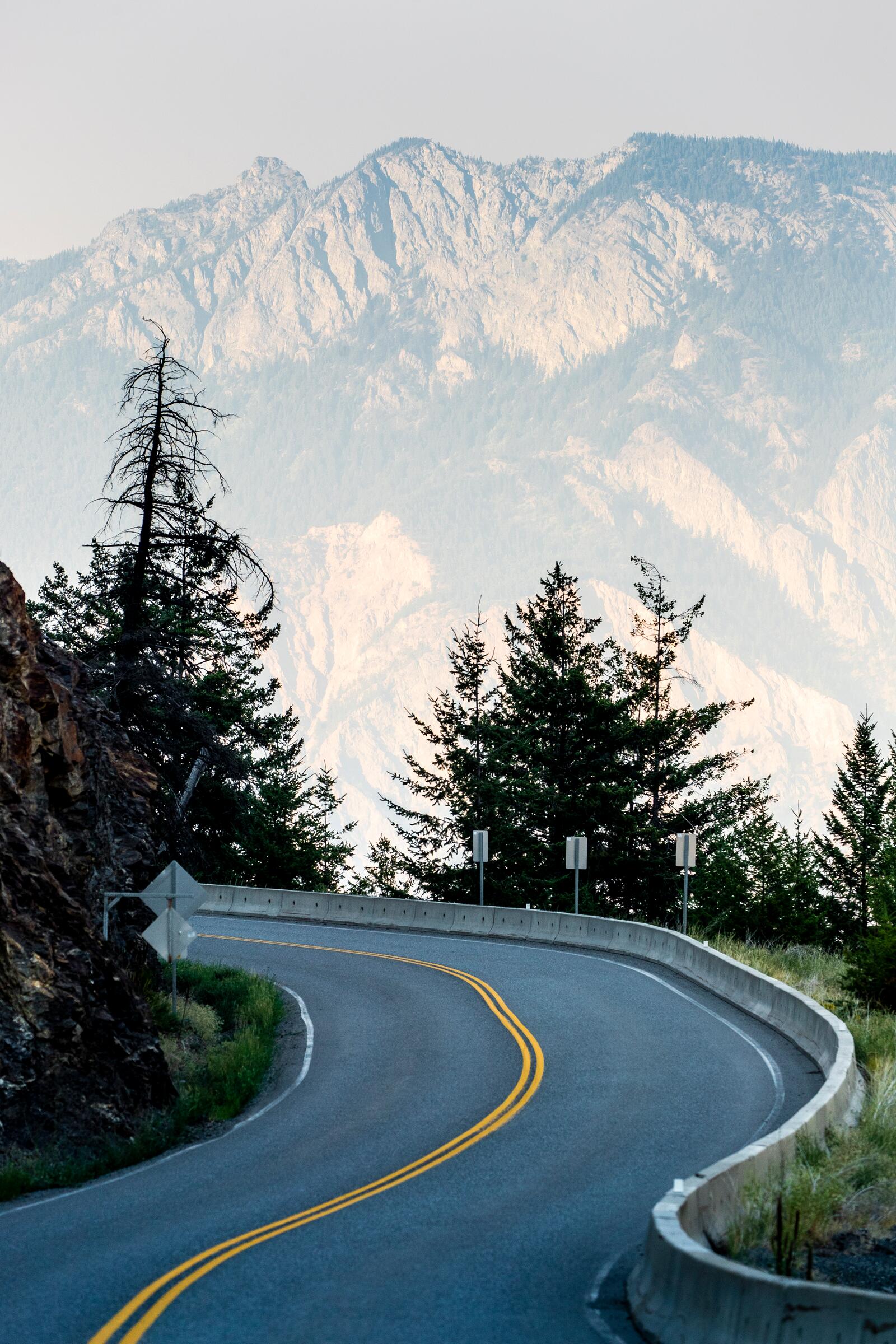
You're descending into Hope on Highway 3. A truck passes at 110, close enough to feel. Whatever happens next, the rules that apply are in BC's Motor Vehicle Act (MVA), a law written mostly with cars in mind.
That law is being rewritten. The province updated it in 2024 to require a minimum passing distance, and consultations on the next round of changes are underway now. Two of our founding partners, HUB Cycling and the BC Cycling Coalition, have put forward 25 recommendations for what those changes should be. Their top asks are solid: 30 km/h default limits on neighbourhood streets, no right turns on red, a three-second following distance behind people on bikes.
We read all 25 with a different rider in mind. Not the commuter on Commercial Drive, but the person three days into a loaded tour, on a rural highway, crossing a rail corridor, rolling into a town they've never seen. Some of the recommendations that matter most for that rider sit well down the urban priority list. Here are our five.
Space at railway crossings. Crossing rail tracks at a bad angle is one of the most common ways touring cyclists crash, and it's terrifying to line up a crossing with a vehicle close behind you. One US study found that fixing the crossing angle at a single rail crossing cut single-bike crashes by 98 percent. Recommendation 23 would require drivers to give cyclists room to cross tracks and cattle guards safely. Almost invisible in urban advocacy. Huge on the Kettle Valley Rail Trail, or any rural route.
Side-by-side riding. Pairs and groups tour together, and current law effectively requires single file. That makes nearly every touring group technically offside, and gives impatient drivers a pretext. Recommendation 17 would make riding two abreast legal when it's safe.
Real consequences for dangerous driving in big vehicles. In the city, the answer to traffic danger is protected infrastructure. On a rural highway there is no infrastructure. There's just whether the driver of the truck gives you room. Recommendation 13 would lower the threshold for licence suspension, raise fines for the largest vehicles, and make retraining routine after repeat offences.
Stop signs as yields. On a multi-day ride you stop at a lot of empty rural intersections. The "Idaho stop" lets cyclists treat a stop sign as a yield: slow, look, proceed if clear. Idaho's cyclist injuries dropped 14.5 percent the year it took effect, and HUB Cycling already advocates for it here.
Smarter vehicle speeds. The speed gap between a loaded bike and highway traffic is largest exactly where cycle tourists ride. Recommendation 10 would expand GPS-aware speed limiters, technology the European Union already requires in new vehicles.
The full list, with our take on all 25, is in the appendix at the bottom of this page.
None of this replaces the urban asks. It adds a lens: visitors on unfamiliar roads, loaded bikes, rail corridors, town connectors. If BC wants to be a place people come to ride, the law underneath every route matters as much as the routes themselves.
Have your say. The BC Cycling Coalition is surveying riders to shape what goes to the province, and they'll be sharing the results with government. Membership is free and takes a minute: take the survey. If you ride BC's rural roads, your perspective is exactly what's missing from this conversation.
— Heather
Appendix: all 25 recommendations, through a cycle tourist's lens#
The full list from HUB Cycling and the BC Cycling Coalition's updated MVA reform recommendations (2024), in the order they scored them, with our read on what each one means for people touring BC by bike.
| # | Recommendation | Our take |
|---|---|---|
| 1 | Default 30 km/h limit on local streets without centre lines | Medium. Every tour passes through towns, and slower streets make unfamiliar ones gentler. Mostly a residential-street change. |
| 2 | No right turns on red for motor vehicles | Medium-high. Removes a common conflict point at the intersections you meet entering and leaving town. |
| 3 | Welcome wheelchairs and mobility scooters on cycling routes | Low for touring specifically, though it makes shared paths more welcoming for everyone. |
| 4 | Allow small children on sidewalks at walking speed | Nil for touring. Matters for families, not multi-day trips. |
| 5 | Three-second following distance behind vulnerable road users | High. Being tailgated by fast traffic is a constant on rural highways. An enforceable buffer matters most where there is no bike lane to retreat to. |
| 6 | Fines for blocking bike lanes, with automated enforcement | Medium. Mostly protects urban bike lanes. Relevant when your route crosses a city. |
| 7 | Let cyclists use the pedestrian head-start signal at intersections | Medium. Simpler intersections help riders who don't know them. |
| 8 | Remove the mandatory adult helmet law | Mainly affects spontaneous and urban visitor cycling, bike share especially. Touring riders generally bring helmets, so the impact on multi-day trips is small. |
| 9 | Make "elephant's feet" crossings a provincial standard | Low. A consistency fix with a small benefit at town crossings. |
| 10 | Expand GPS-aware speed limiters | High. The speed gap between bikes and traffic is biggest on the rural highways where tours happen. Anything that brings vehicle speeds down there cuts the worst risk. |
| 11 | Stop sign as yield for cyclists (the Idaho stop) | High. Touring means hundreds of rural stop signs. Slowing and proceeding when it's clearly empty beats unclipping at every one. HUB Cycling already advocates for this. |
| 12 | Allow passing on the right on shoulders and bikeways | Low. A technical legal fix, rarely an issue on touring routes. |
| 13 | Stronger penalties and retraining for dangerous driving, higher fines for the largest vehicles | High. On a rural highway there is no protected lane, just the driver's choices. Heavy vehicles are the biggest fatality risk touring cyclists face. |
| 14 | Allow bicycles in rightmost bus lanes | Low. Urban only. |
| 15 | Modernize cyclist signalling rules | Low. A clarification, though a welcome one on a loaded bike when taking a hand off the bars is unsafe. |
| 16 | Clarify right-of-way at roundabouts and traffic circles | High. Roundabouts are everywhere in resort towns, and nobody is quite sure who yields to whom. Clear rules help visitors most of all. |
| 17 | Allow side-by-side riding where safe | High. Pairs and groups tour together, and the single-file rule makes that technically illegal, which some drivers treat as an invitation. |
| 18 | Require side guards on heavy trucks | High. Underride crashes happen on rural highways, where touring cyclists and trucks share the same lane. |
| 19 | Drivers must yield to a cyclist continuing through an intersection | High. Getting cut off by turning vehicles is a constant hazard when you're following a route through unfamiliar intersections. |
| 20 | Tighten safe passing to 1.5 m at speeds under 50 km/h | Medium. BC's 2024 one-metre passing law was a real step. This strengthens it. |
| 21 | Clarify that cyclists ride as near to the right as is safe, not as far right as possible | High. Loaded bikes need room to avoid debris, grates, and rough shoulders. Legal clarity protects riders who are already doing the right thing. |
| 22 | No duty to pull right just because a driver honks | Medium. A horn should not be able to legally push you into the gravel. |
| 23 | Drivers must give cyclists space to cross railway tracks and cattle guards | Very high. Crossing tracks at an angle with a vehicle close behind is one of the scariest moments in rural touring. Barely mentioned in urban advocacy. Huge on rail trails and in ranch country. |
| 24 | Rename the Act to the "Road Safety Act" | Symbolic. No practical effect on a ride. |
| 25 | Let cyclists proceed past the stop line to trigger a signal | Low, but real: plenty of signals never detect a bicycle. |
Sources: Modernizing the BC Motor Vehicle Act, HUB Cycling and BC Cycling Coalition (2024); rail crossing research, University of Tennessee; stop-as-yield fact sheet, NHTSA.