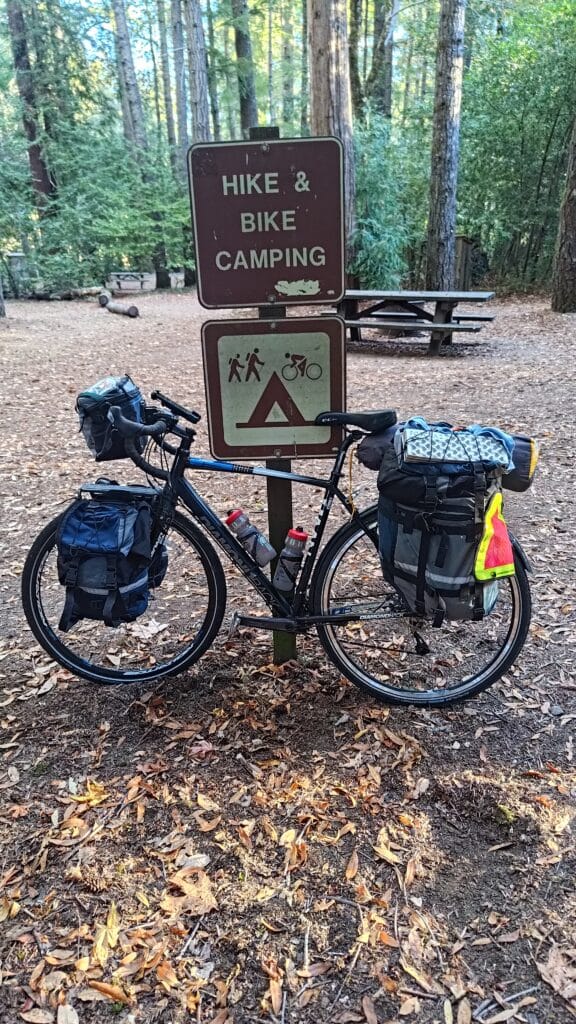
The single most useful thing a campground can do for cycle tourism costs almost nothing: promise that someone who arrives by bike will always be found somewhere to sleep, even when every site is booked.
In January 2026, seven cycling and outdoor recreation organizations asked Metro Vancouver Regional Parks to adopt exactly that, as part of its Regional Parks Camping Opportunities Study. Four more organizations sent letters of support, including Destination British Columbia and Trans Canada Trail.
A cyclist cannot camp the way a driver can. Weather, fatigue, injury, and mechanical trouble make it hard to commit to a date months ahead, which is what a reservation system asks for. Arriving early to claim a first-come, first-served site is hard when you spend the day riding. And if the campground is full at the end of a long day, riding another 40 km is not a small adjustment.
There are practical differences too. A cyclist has no car trunk to keep food away from animals. Distance is the constraint that shapes everything, so sites in many parks matter more than lots of sites in one park.
None of this is unusual or extreme. It is what self-contained cycle touring is normally like. The 2025 Metro Vancouver camping study did not consider it at all.
1. Adopt a no turn-away policy. Anyone arriving by active transportation gets a place for the night, even when the campground is full, in a communal overflow space or small scattered areas.
2. Add hiker, biker, paddler, and transit sites inside existing campgrounds. Small tent sites, or a shared non-vehicle area, within campgrounds that already exist.
3. Add camping to parks and greenways that have no campground at all. Alongside trails, group campgrounds, or day-use areas.
4. Install what makes it work. Food storage lockers to deter bears and raccoons, safe bike access to and within the campground, and basics like potable water and washrooms. Cyclists can manage on very little, but food storage is the one that matters.
5. Market it. Metro Vancouver already sits on several long-distance routes, including the Trans Canada Trail, Experience the Fraser, the Great Blue Heron Way, and the Pacific Coast route. Word travels fast among cyclists.
Of the five, the letter is explicit about which matters most: a no turn-away policy is the single most impactful change.
Quebec. 103 campgrounds certified under Bienvenue cyclistes!, including 17 provincial and Sépaq parks.
Washington State. All 30 state park campgrounds, under a policy adopted in 2000. State parks in ten more American states have since followed.
British Columbia. The Capital Regional District includes tent sites for cyclists at the Sooke Potholes Regional Park campground, and BC Parks operates 19 walk-in campgrounds.
Alberta. Hiker and biker areas added in 2021 at Spray West Campground, Buller Mountain and Sawmill day-use areas, and Pocaterra overflow campground.
The Chesapeake and Ohio Canal towpath. More than 30 primitive hiker and biker sites, one every 10 to 15 km along the trail.
The Pacific Coast bike route. A continuous corridor of hiker and biker sites through Washington, Oregon, and California that riders plan multi-week trips around.
The letter was signed by Trails BC, the BC Cycling Coalition, HUB Cycling, the Outdoor Recreation Council of BC, the UBC Varsity Outdoor Club, Let's Go Biking, and Our Community Bikes.
Letters of support came from Destination British Columbia, Trans Canada Trail, the Federation of Mountain Clubs of BC, and BC Marine Trails. The Metro Vancouver Regional Parks Foundation and CTS Youth Society also expressed support.
The support letters make a point worth repeating: this is not only about cyclists. Hikers, paddlers, and people arriving by transit all need the same thing, which is a way to camp that does not assume a car. BC Marine Trails added one caveat we think is right, that a no turn-away policy should cover individuals and small groups, not commercial tour groups.
Republished with permission from Trails BC, where it first appeared. The letter was written by Heather Piwowar while she was on the Trails BC board, and submitted by Trails BC on behalf of all the signatories.
No turn-away is one of the things BC Cycle Tourism Society advocates for province-wide, and a commitment we hope campgrounds will make on their own. If you run a campground and want to talk it through, or you have been turned away and want to tell us about it: heather@bccycletourism.ca